Imagine standing quietly in the African bush as the sun rises over the horizon. A fresh set of elephant tracks crosses the sandy path beneath your feet, while your guide points out the alarm call of a nearby francolin. A few hours later, you’re watching a pride of lions resting beside your safari vehicle as your guide explains their behaviour. Both are unforgettable moments, yet they offer two completely different ways to experience Africa’s wilderness.
This is one of the most common questions travellers ask when planning an African safari: Should I choose a walking safari or a game drive?
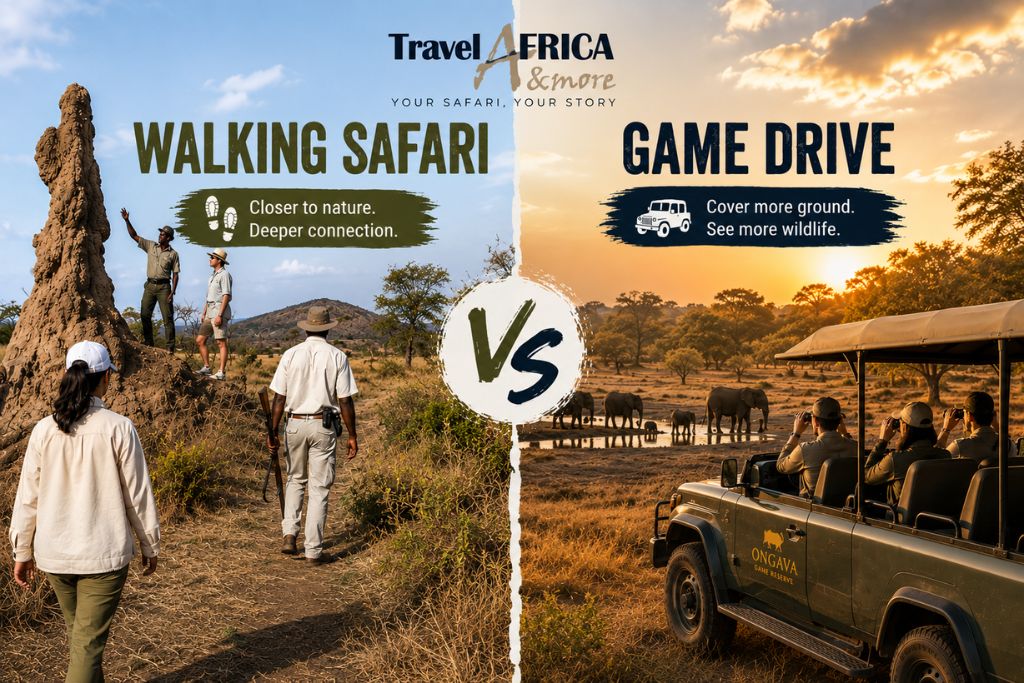
The answer isn’t as simple as picking one over the other. Both experiences showcase Africa’s remarkable wildlife, but from entirely different perspectives. A game drive helps you cover vast landscapes in search of iconic animals, while a walking safari slows everything down, letting you experience the bush through its sights, sounds, tracks, and hidden details.
This guide breaks down exactly how each experience works, where each excels, and why many seasoned travellers believe the best safari combines both.
A game drive is a guided wildlife excursion in an open safari vehicle, designed to cover larger areas and maximise sightings, including the Big Five. It’s the classic safari experience most people imagine.
A walking safari is a guided bush walk led by an experienced guide, exploring the wilderness on foot while learning about tracks, plants, birds, insects, and the relationships that hold the ecosystem together.
Choose a game drive if you:
- Are you visiting Africa for the first time
- Want the best chance of seeing the Big Five
- Enjoy wildlife photography
- Prefer a more comfortable pace
- Are you travelling with children or older family members
- Want a deeper understanding of the bush
- Enjoy nature beyond large mammals
- Like slower, more immersive experiences
- Have safari experience already and want something new
- Appreciate learning directly from expert guides
What Is a Safari, Really?
The word safari comes from Swahili, meaning “journey,” with roots in the Arabic safar (to travel). It once described long expeditions across East Africa for trade, exploration, or hunting. Today, safaris centre on wildlife observation, conservation, photography, and responsible travel. This is where many first-timers get confused: a safari is the overall journey, while a game drive and a walking safari are two of the activities you might do during it, alongside boat safaris, canoe trips, or mokoro excursions, depending on the destination. Interestingly, South African lodges often use the term “game drive” more than “safari” for daily activities, a reflection of local usage rather than a different meaning. International visitors, meanwhile, tend to use “safari” to describe the whole trip. Both are correct. A safari is about more than ticking off famous animals; it’s about watching the landscape shift from sunrise to sunset, learning how guides read fresh tracks, and discovering how every creature, plant, and predator depends on one another.What Is a Game Drive?
A game drive is a guided wildlife-viewing excursion in a specially designed safari vehicle, aimed at observing animals in their natural habitat while learning about their behaviour and ecology from an expert guide. Guides don’t just drive along roads; they interpret fresh tracks, identify alarm calls, and understand where wildlife is likely to be at different times of day. No two drives are ever the same: one morning might bring elephants feeding beneath acacia trees and a leopard resting in a sausage tree; another might centre on a cheetah hunt or a buffalo river crossing.How It Works
Most game drives use open-sided 4×4 vehicles offering elevated seating, unobstructed views for photography, and access to areas standard vehicles can’t reach. Vehicles typically carry 4-10 guests, though luxury lodges often keep numbers lower for a more personal experience. Throughout the drive, guides watch for footprints, droppings, scratch marks, alarm calls, dust clouds, and circling vultures,0 subtle clues that often lead to remarkable sightings.When Game Drives Happen
- Morning drives begin before sunrise, when cooler temperatures keep animals active. Expect lions returning from a hunt, leopards before they retreat into cover, and excellent early light for photography.
- Afternoon and evening drives run into sunset, catching elephants at waterholes, herds on the move, and often ending with a classic sundowner.
- Night drives, permitted in many private reserves, use filtered spotlights to reveal species rarely seen by day — civets, genets, porcupines, bush babies, and honey badgers.
Types of Game Drives
- Guided game drives — the most popular option, with an expert guide handling both driving and interpretation.
- Self-drive game drives — available in parts of South Africa and Namibia, offering flexibility and lower cost but no expert commentary.
- Private game drives — exclusive vehicles for guests wanting more time at sightings, flexible timing, or a focus on photography or birdwatching.
What You Might See
Game drives offer the best odds of spotting lions, leopards, elephants, giraffes, zebra, wildebeest, buffalo, hippos, and rhino, along with antelope species like impala, kudu, and eland, plus hyenas, wild dogs, and (where present) up to 300–500 recorded bird species.Who It Suits Best
Game drives work well for first-time visitors, families, photographers, birdwatchers, senior travellers, and anyone with limited mobility, essentially anyone hoping to maximise their chances of seeing Africa’s headline wildlife in comfort.What Is a Walking Safari?
A walking safari trades speed and distance for depth and detail. Rather than searching for as many animals as possible, guides encourage guests to slow down: examining fresh lion tracks, watching a termite colony at work, or working out why a herd of impala suddenly stopped grazing. You’ll typically cover 3–10 km on foot, compared to 20–80 km or more on a game drive, but you’ll come away with a far richer understanding of how the ecosystem actually functions.Side-by-Side Comparison
| Feature | Walking Safari | Game Drive |
| Experience | Slow, immersive exploration on foot | Wildlife viewing from an open vehicle |
| Primary focus | Nature, tracking, ecology, learning | Finding wildlife, covering large areas |
| Wildlife sightings | Fewer species, deeper understanding | Greater variety, including the Big Five |
| Big Five chances | Possible, but not the main goal | Excellent, where they occur |
| Photography | Landscapes, birds, plants, storytelling | Wildlife, predators, close-ups |
| Comfort | Requires walking on natural terrain | Comfortable seating, minimal effort |
| Fitness level | Moderate fitness recommended | Suitable for most travellers |
| Children | Often age-restricted | More family-friendly (policies vary) |
| Accessibility | Limited on uneven terrain | Better for limited mobility |
| Distance covered | ~3–10 km | Often 20–80+ km |
| Best for | Nature lovers, repeat travellers, birders | First-timers, photographers, Big Five seekers |
Wildlife Sightings
Because vehicles cover far more ground across varied habitats — grasslands, riverbanks, woodlands, waterholes — game drives generally deliver more sightings and greater variety. Walking safaris trade quantity for quality: you may see fewer large mammals, but you’ll understand why they’re behaving the way they are.Big Five Sightings
If ticking off lion, leopard, elephant, rhino, and buffalo is a priority, a game drive gives you the best odds, since vehicles can reposition quickly and cover more ground. Walking safaris can still deliver Big Five encounters, especially elephants and buffalo, and sometimes lions or rhinos from a safe distance, but these are never guaranteed and aren’t the point of the exercise.Birdwatching
Africa hosts more than 2,300 bird species. Game drives are great for spotting larger, more visible birds like secretary birds, ostriches, and martial eagles across open landscapes. Walking safaris, moving slowly and quietly, are better suited to smaller species — bee-eaters, kingfishers, sunbirds, and barbets, along with nests, feathers, and calls that vehicles simply pass by.Photography
Game drives suit classic wildlife photography: stable positions, room for long lenses, and elevated views ideal for predators and action shots. Walking safaris lend themselves to a different style, landscapes, tracks, insects, textures, and wide environmental scenes that tell the story of the bush itself rather than just documenting sightings.Comfort and Pace
Game drives require little physical effort — you sit back while your guide navigates. Walking safaris ask more of you: sand, grass, rocky paths, and dry riverbeds, with regular stops. Neither is physically demanding for a healthy adult, but walking naturally requires more mobility.Learning Experience
This is where walking safaris really shine. On foot, nearly everything becomes a lesson, identifying tracks, reading bird alarm calls, distinguishing tree species, and understanding the relationships that keep the ecosystem running. Many travellers say a walking safari leaves them with a far deeper appreciation of the wilderness than they expected. In short: a game drive asks, “Where can we find wildlife today?” A walking safari asks “How does this wilderness actually work?” Neither replaces the other — which is exactly why the best itineraries include both.Is a Walking Safari Safe?
It’s a fair question — the idea of walking where lions, elephants, and buffalo roam can sound intimidating. But guided walking safaris have operated safely across Africa for decades, in places like South Luangwa (Zambia), Mana Pools (Zimbabwe), the Greater Kruger region (South Africa), and select reserves in Botswana and Tanzania. The keyword is guided. These are never casual bush walks, they’re carefully managed experiences led by professionals who continuously assess wind direction, fresh tracks, animal behaviour, terrain, and visibility, adjusting or ending the route if conditions change.Who Leads the Walk
Depending on local regulations, the guiding team may include a qualified walking guide, a second guide or tracker, and, where required,, an armed ranger. A firearm is a last resort, not a routine tool; guides rely first on experience and knowledge to avoid dangerous situations before they develop.The Safety Briefing
Before every walk, guests are briefed to stay together, walk in single file when instructed, keep voices low, avoid sudden movements, never run if wildlife is encountered, and follow the guide’s directions immediately.Encountering Wildlife
Guides read behaviour before deciding how to respond. Relaxed, feeding elephants might be observed quietly from a distance; an agitated herd with calves means the guide increases distance or changes route. Buffalo and lions are treated with similar caution; the goal is always observation, never interaction. Leopards are naturally elusive and rarely encountered up close on foot at all. Most wild animals prefer to avoid conflict. A calm, predictable group moving together, led by someone who can read warning signs, rarely triggers confrontation; most encounters simply end with the animal continuing on its way.Game Drives and Safety
Game drives involve less physical exposure, since guests stay inside the vehicle, and animals in many reserves are accustomed to vehicles behaving predictably. This makes game drives a common choice for families, older travellers, and anyone nervous about walking in the bush.A Few Practical Tips
- Listen carefully during the safety briefing
- Stay with your group at all times
- Wear comfortable, grippy walking shoes and neutral-coloured clothing
- Never approach wildlife for a closer photo
- Trust your guide’s instructions, even before you understand why