
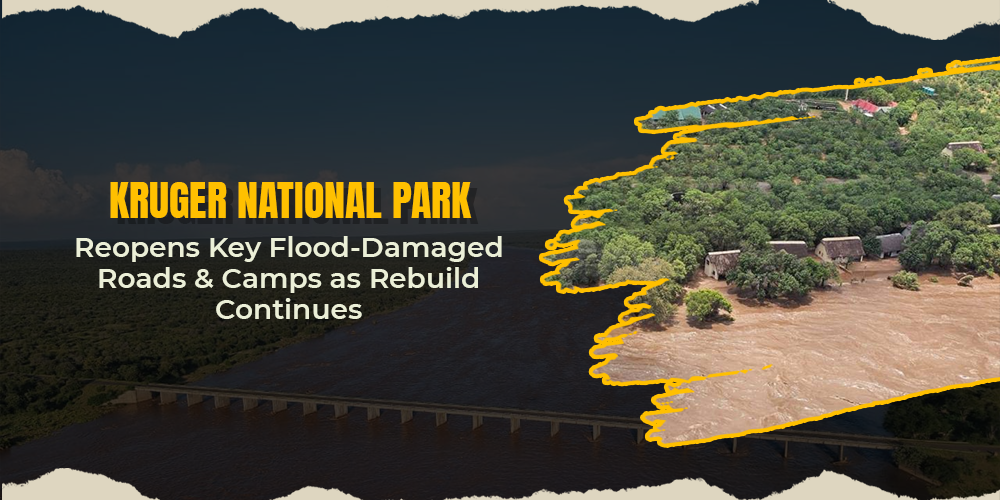
Kruger National Park Reopens Key Flood-Damaged Roads and Camps as Rebuild Continues
Kruger National Park has reopened several major roads, bridges, and tourism facilities that were damaged by severe flooding, as South Africa’s Department of Forestry, Fisheries and the Environment pushes ahead with a rebuild programme now estimated at R950 million.
Quick Summary
- Key infrastructure on the H4-1 road between Skukuza and Lower Sabie, the Letaba High-Level Bridge, and tourism units at Letaba Rest Camp have reopened after flood damage repairs.
- The wider Kruger flood recovery programme is now estimated at R950 million, almost double the original R500 million projection following the severe January 2026 floods.
- Environment Minister David Maynier has urged that future infrastructure be built with greater resilience to increasingly extreme weather.
- The reopening coincides with the start of South African National Parks Week, running from 7 to 13 September, offering free day access to several parks.
- Further restoration work at Letaba Rest Camp is expected to be completed in phases by 30 November.
What Happened
Roads, bridges, and visitor facilities across Kruger National Park sustained extensive damage from severe flooding, disrupting some of the park’s busiest tourist routes and rest camps. As part of an ongoing recovery effort, several major projects have now been completed and reopened to visitors.
Among the key milestones:
- H4-1 Road (Skukuza–Lower Sabie): Culverts damaged during flooding were reconstructed over a 10-month project costing R37.5 million, completed on 31 July. The upgraded culverts feature wider openings to handle greater water flows, along with stone pitching to protect embankments from future erosion. This route is one of Kruger’s busiest, supporting tourism traffic as well as conservation operations, staff movement, and emergency response.
- Letaba High-Level Bridge: This bridge, which connects the northern and southern sections of the park, reopened to traffic on 23 March after construction work began in early February 2026. Final touches, including road sealing, were completed on 28 August. The R9.5 million project also included drainage improvements and stone pitching at the bridge approach.
- Letaba Rest Camp: Twenty-five tourism units damaged in the January floods, including 10 family cottages, have been restored at a cost of R19 million, complete with new furniture. A further 64 units are being restored in phases, with completion expected by 30 November.
Minister Calls for Climate-Resilient Rebuilding
Speaking during a visit to the park to mark the completion of these projects, Environment Minister David Maynier said recovery efforts should go beyond simply rebuilding what was lost, calling for infrastructure that strengthens resilience and reduces vulnerability to future extreme weather events.
He noted that reliable roads, bridges, and visitor facilities are essential not only for tourists but also for park rangers, scientific researchers, and emergency responders operating within Kruger. The minister also called on the tourism industry, financial institutions, and other private sector partners to collaborate with South African National Parks (SANParks) on building more climate-resilient infrastructure going forward, suggesting Kruger could serve as a model for similar upgrades across the country’s other national parks.
What This Means for Travellers
For safari-goers and Kruger visitors, the reopening of these routes and facilities restores easier access between key parts of the park, including the well-travelled corridor between Skukuza and Lower Sabie and the northern-southern link via the Letaba Bridge. Visitors booking stays at Letaba Rest Camp should note that some units remain under restoration, with full capacity expected by the end of November.
Travellers planning a visit this month can also take advantage of South African National Parks Week, running from 7 to 13 September, which offers South African day visitors free access to participating parks. In Kruger, along with West Coast and Augrabies Falls national parks, free entry applies from 7 to 11 September. This offer covers day access only and excludes accommodation, guided activities, and game drives.
The Bigger Picture
The scale of the rebuild nearly double the original cost estimate highlights the growing financial and logistical impact of extreme weather events on Africa’s flagship conservation destinations. As climate volatility increases, the approach taken in Kruger, prioritising resilience alongside restoration, may set a precedent for infrastructure planning across other national parks and safari destinations on the continent.
Travel operators and visitors are advised to check current road and camp status directly with SANParks before finalising Kruger itineraries, as restoration work in some areas is still ongoing.





![Some journeys are even more special when shared.
Imagine waking up to the sounds of the African bush, exploring Kenya’s remote conservancies together, enjoying private picnics and spending nights beneath endless African skies.
From The Emakoko and Lewa House to Ol Malo Lodge and Sarara Treehouses, this romantic Kenya safari brings together four extraordinary stays, each offering a different side of the wilderness.
2027 Long Stay Savings: Enjoy 10% OFF on stays of 5+ nights. Select dates apply.
Whether you're planning a honeymoon, anniversary or simply an unforgettable escape for two, we'll help you create a safari that feels entirely your own.
📩 DM us to start planning your romantic Kenya safari.
[Kenya Honeymoon Safari, Luxury Kenya Safari, Romantic Safari, Kenya Safari for Couples, Lewa Conservancy, Laikipia, Sarara Treehouses, Bespoke African Safari]](https://travelafricamore.com/core/modules/313e568472/img/placeholder.png)