
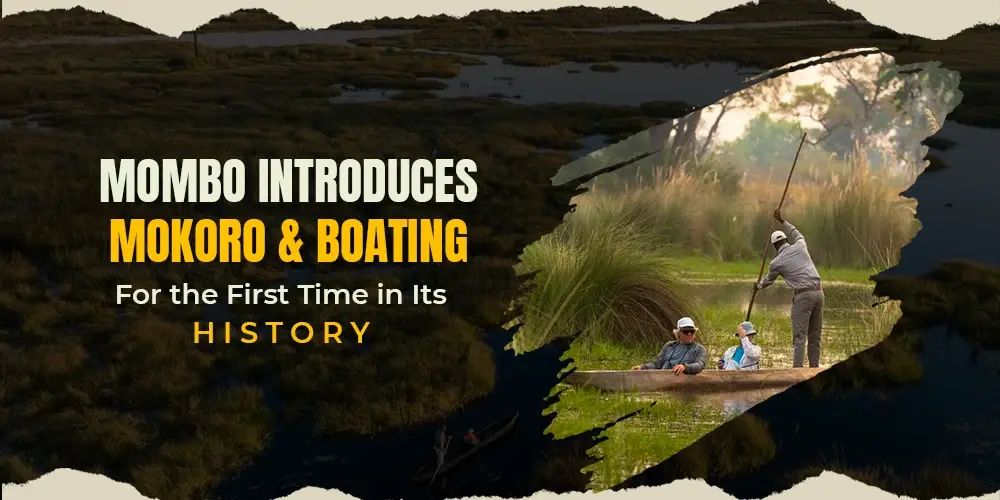
Mombo Introduces Mokoro and Boating - For the
First Time in Its History
For nearly 30 years, Wilderness Mombo has been spoken about in a specific way: as the camp you visit when you want the very best game viewing Botswana has to offer. It sits on a private, 45,000+ hectare concession on the northern tip of Chief’s Island, inside the Moremi Game Reserve, an area so consistently rich in wildlife that the Yei people who have known this land the longest named it Mombo, “the place of plenty.”
Until now, that reputation has been built entirely on land. Game drives, walking hides, the occasional night under canvas listening to lion calling across the floodplain. Water was something you looked at from your deck, not something you moved through.
That’s changed. Mombo has introduced mokoro and boating activities for the first time in its history, giving guests a way to experience the same wildlife-dense landscape from the water, not just from a vehicle.
Why This Is a Bigger Deal Than It Sounds
Boating and mokoro aren’t new to the Okavango Delta. Camps in the deeper, more permanently flooded parts of the Delta – Xigera, Little Vumbura, Khwai, have offered water-based activities for years, because their locations are naturally wet for most or all of the season.
Mombo has never been one of those camps. Its concession sits on Chief’s Island itself, which is largely dry land surrounded by floodplain, brilliant for game drives, but not historically set up for boating. The fact that Mombo can now offer it, even seasonally, says something about how the camp’s access to the surrounding waterways has evolved, and it opens up an entirely new dimension to a stay that was previously land-only.
For travelers, it means Mombo no longer has to be a trade-off between “best game viewing” and “water experience.” For the first time, it can be both.
Mokoro: The Traditional Way Through the Delta
A mokoro is a traditional dugout canoe (today, most are fibreglass for sustainability, built to the same shape) poled through shallow water by a skilled local poler standing at the stern. It’s the oldest way of moving through the Delta, and still the quietest.
Sitting just inches above the waterline, a mokoro moves through reeds and lily pads without a sound. There’s no engine, no wake which means birdlife and smaller wildlife along the water’s edge tend not to scatter the way they might from a boat. Guests often describe it as the closest thing to being part of the ecosystem rather than observing it from outside.
Mokoro excursions are typically shorter, more intimate outings well suited to photography, birdwatching, and simply slowing down after a morning of game drives.
Boating: Covering More Ground
Boating, by contrast, uses a small motorised craft and covers considerably more distance. It’s a better option for exploring wider channels and reaching parts of the floodplain that would take a long time to cover by mokoro.
From a boat, guests get a different vantage point on the same landscape, sightings of hippo, crocodile, elephant crossing water, and water-associated birdlife like African fish eagles, saddle-billed storks, and, if you’re fortunate, the elusive Pel’s fishing owl. It’s a good complement to a mokoro outing rather than a replacement for it: where mokoro rewards patience and quiet, boating rewards range.
When You Can Actually Experience This
One detail most coverage of this launch has left out: both activities depend on seasonal water levels. The Delta’s flood arrives from Angola’s highlands and typically peaks between June and August, sometimes into September. Outside that window, water may be too low for mokoro or boating to run.
June to September is the sweet spot, high water combined with the dry season’s excellent game viewing. October can work in a good flood year but is less predictable. November to April (green season) is unlikely to support water activities, though it offers lush scenery and quieter, lower-rate travel.
If this is a priority for your trip, build it into planning early and confirm conditions closer to your travel dates.
The Camp Itself
Mombo has nine spacious tented suites, plus three at sister camp Little Mombo, connected by a raised wooden walkway. Rooms sit on elevated decks over the floodplain, with indoor/outdoor showers and roll-top or plunge baths. The camp is fully solar-powered, with an on-site spa, gym, and photographic studio.
Mombo has also played a key role in Botswana’s black and white rhino reintroduction programme, and sightings of both are possible on Chief’s Island today as a result. One operational note: because the concession sits within Moremi Game Reserve, night drives aren’t permitted, a standard rule across the reserve, not specific to Mombo.
Ways to Save on Your Mombo Stay
A few current Wilderness offers pair well with a Mombo trip:
- Long Stay Discount – 5% off accommodation for stays of 6+ nights, in low season (not valid 1 June–31 Oct or 20 Dec–5 Jan).
- Wilderness Botswana Free Flying – Book 6+ nights across Wilderness Botswana camps and get your first 3 flight/road legs free (more legs free at 8, 11, 13, or 15+ nights).
- No Single Supplement – Waived for the first two solo travelers in a booking, in low and shoulder seasons.
- Wilderness Honeymoon Special – 50% off accommodation for one spouse, for travel within 6 months of the wedding.
(Kids Stay Free doesn’t apply at Mombo or Little Mombo, worth knowing if traveling with children.) Terms and season restrictions apply to all offers, happy to check what stacks best for your dates.
Our Take
We’re visiting Mombo and Little Mombo ourselves this November, and will share firsthand, current-season insight once we’re back, including how the water’s looking at that time of year.
In the meantime, if a Mombo stay is on your radar, reach out. Given how conditions-dependent these new activities are, it’s worth getting the timing right at the planning stage.




![Some journeys are even more special when shared.
Imagine waking up to the sounds of the African bush, exploring Kenya’s remote conservancies together, enjoying private picnics and spending nights beneath endless African skies.
From The Emakoko and Lewa House to Ol Malo Lodge and Sarara Treehouses, this romantic Kenya safari brings together four extraordinary stays, each offering a different side of the wilderness.
2027 Long Stay Savings: Enjoy 10% OFF on stays of 5+ nights. Select dates apply.
Whether you're planning a honeymoon, anniversary or simply an unforgettable escape for two, we'll help you create a safari that feels entirely your own.
📩 DM us to start planning your romantic Kenya safari.
[Kenya Honeymoon Safari, Luxury Kenya Safari, Romantic Safari, Kenya Safari for Couples, Lewa Conservancy, Laikipia, Sarara Treehouses, Bespoke African Safari]](https://travelafricamore.com/core/modules/313e568472/img/placeholder.png)