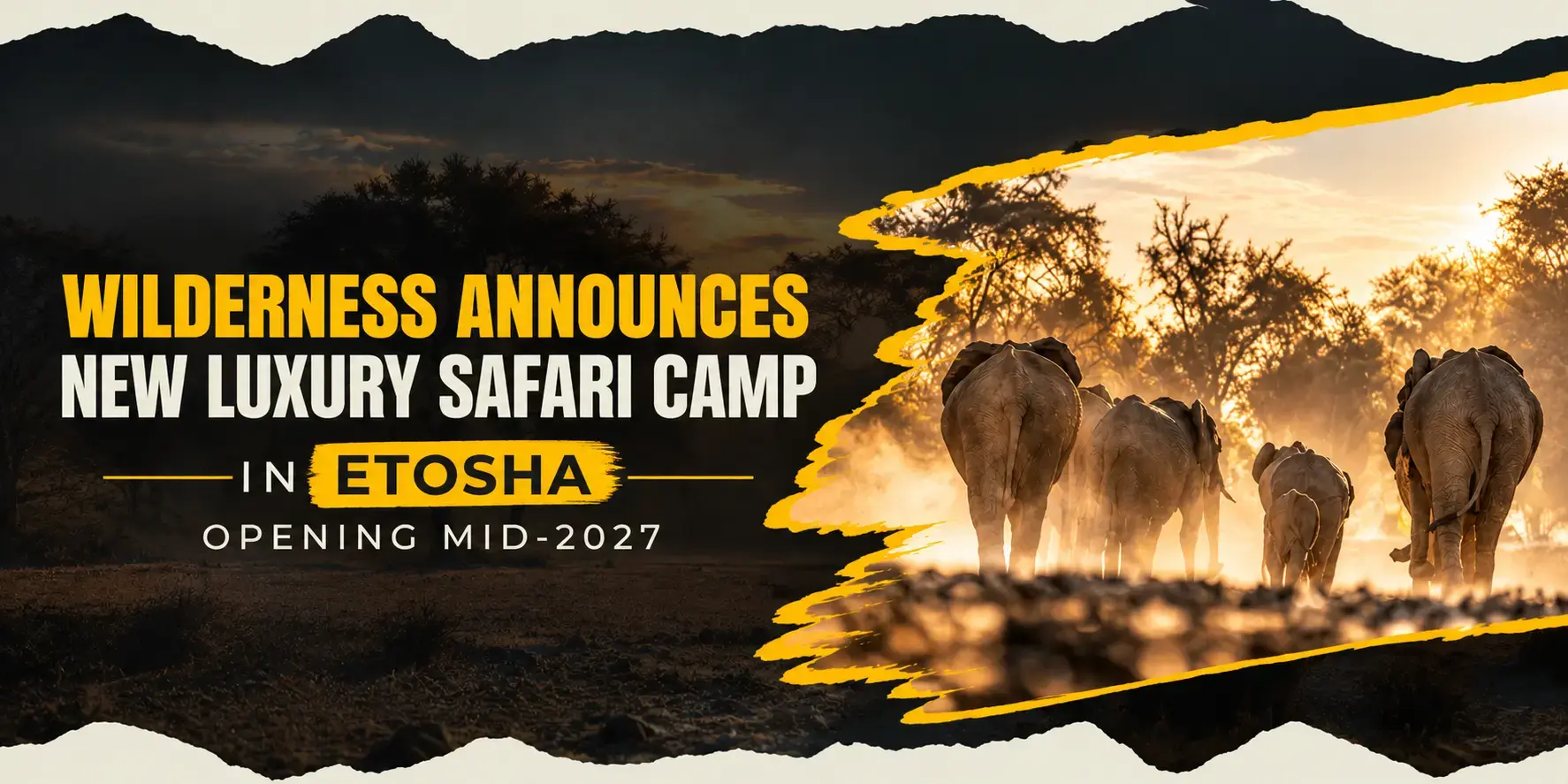
Wilderness Announces New Luxury Safari Camp in
Etosha - Opening Mid-2027
Wilderness has announced its next new camp: Wilderness Etosha, an eight-suite property in the Hobatere Concession on the western boundary of Etosha National Park, opening mid-2027. It’s Wilderness’s first camp in this part of Namibia — a landscape most visitors to Etosha never actually see.
Why This Is a Bigger Deal Than It Sounds
Most travelers know Etosha for its vast salt pan and the floodlit waterholes that draw game in the dry months — that’s the Etosha most photographs show. Hobatere is a different side of the same ecosystem entirely: rugged mountains, dry riverbeds, and natural springs on the park’s western edge, forming part of what Wilderness calls the Etosha–Skeleton Coast land bridge — a roughly 55,000 km² conservation corridor linking Etosha National Park, 14 communal conservancies, and the Skeleton Coast.
That corridor matters more than it might sound. Research shows elephants spend relatively little time inside national park boundaries, relying instead on exactly this kind of connected, unprotected land to move between water sources and seasonal ranges. Hobatere sits at one of the key thresholds in that system — placing Wilderness Etosha inside a genuinely important piece of Namibia’s wider conservation landscape, not just a scenic backdrop.
A Different Etosha
The terrain at Hobatere trades Etosha’s open salt pans for rocky mountains, riverine woodland, and hidden springs — the kind of landscape where, as Wilderness puts it, “elephants climb rocky slopes in search of food” and “the smallest signs in the sand reveal stories of survival.” Water availability drives most wildlife movement here, making the concession’s rivers, springs, and waterholes the real center of activity throughout the year.
Species recorded in the area include elephant, lion, leopard, cheetah, brown hyena, spotted hyena, giraffe, Hartmann’s mountain zebra, kudu, and oryx — along with the endemic black-faced impala, found only in this part of north-western Namibia and nowhere else on the continent.
The Camp Itself
Wilderness Etosha will have eight guest suites on a private 4,200-hectare concession. Activities centre on guided walks with wildlife interpretation, private game drives across the concession and a photographic hide positioned at one of its waterholes. These experiences are particularly appealing to travellers who enjoy slowing down and observing wildlife at water sources rather than spending the entire day exploring by vehicle. In-suite wellness treatments complete the offering.
Its location on a private concession bordering Etosha National Park also allows for experiences beyond the park’s public road network and standard visitor activities. This offers a different perspective for travellers seeking a more intimate safari experience away from the busier areas of Etosha.
Our Take
This is a genuinely different kind of Etosha experience — ideal for travellers who have already enjoyed a classic Etosha waterhole safari and want to explore a lesser-visited side of the ecosystem. It also makes a compelling addition to a broader Namibia itinerary that includes Damaraland or the Skeleton Coast, with Hobatere forming part of the conservation corridor connecting these landscapes. With just eight suites and an anticipated mid-2027 opening, Wilderness Etosha is worth considering early for those planning a Namibia safari in 2027 and beyond.
Reach out if you’d like to be among the first to plan a safari featuring Wilderness Etosha.





![Some journeys are even more special when shared.
Imagine waking up to the sounds of the African bush, exploring Kenya’s remote conservancies together, enjoying private picnics and spending nights beneath endless African skies.
From The Emakoko and Lewa House to Ol Malo Lodge and Sarara Treehouses, this romantic Kenya safari brings together four extraordinary stays, each offering a different side of the wilderness.
2027 Long Stay Savings: Enjoy 10% OFF on stays of 5+ nights. Select dates apply.
Whether you're planning a honeymoon, anniversary or simply an unforgettable escape for two, we'll help you create a safari that feels entirely your own.
📩 DM us to start planning your romantic Kenya safari.
[Kenya Honeymoon Safari, Luxury Kenya Safari, Romantic Safari, Kenya Safari for Couples, Lewa Conservancy, Laikipia, Sarara Treehouses, Bespoke African Safari]](https://travelafricamore.com/core/modules/313e568472/img/placeholder.png)