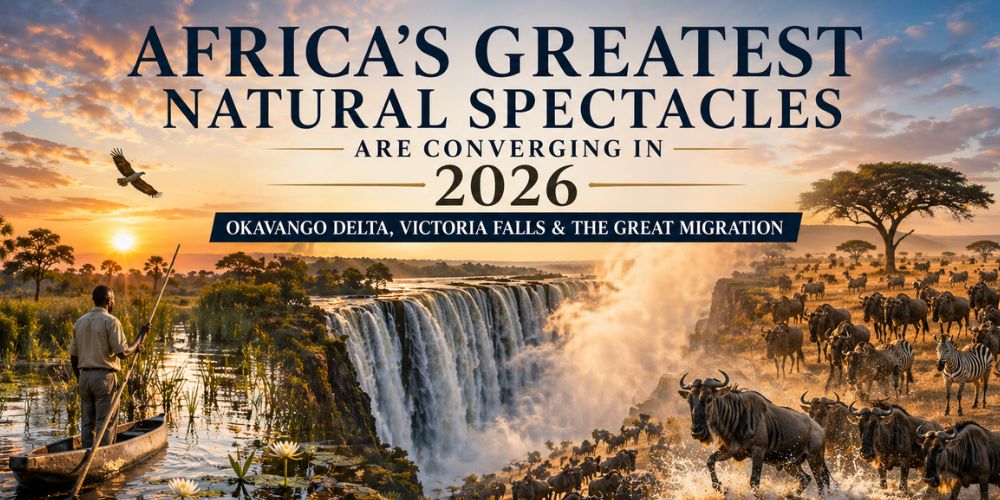
The mokoro barely makes a sound as it parts the papyrus. Your guide, a man whose grandfather taught him to read the Delta’s waterways, dips his pole into water so clear you can count the stems of waterlilies swaying three feet below the surface. A fish eagle calls from somewhere in the flooded forest. Nobody speaks. Nobody needs to.
This is the Okavango Delta in 2026, and it is unlike anything visitors have seen in thirty years.
Far to the north, Angola received more than double its average annual rainfall this season. That water, over 1,000 millimetres where 450 is normal, is now making its 1,200-kilometre journey south through the Cubango and Cuito Rivers, feeding into the Okavango River, and spreading across the Kalahari in one of the most extraordinary flood pulses in living memory. At Victoria Falls, the Zambezi has been thundering at peak force since March, the mist rising 400 metres and visible from 50 kilometres away. And in the Southern Serengeti, two million wildebeest are completing their calving season and beginning the great northward march, the largest movement of land mammals on earth.
Three of Africa’s greatest natural spectacles. One extraordinary year. If you have ever considered a high-end safari in Africa, this guide is for the moment you have been waiting for.
The Science Behind the Season: Why 2026 Is Different
To understand why this year is exceptional, you first need to understand a paradox.
The Okavango Delta, a UNESCO World Heritage Site, the world’s largest inland delta, an inland sea that appears impossibly in the middle of the Kalahari Desert, does not flood when it rains locally. It floods months later, during Botswana’s dry winter, from rainfall that fell in Angola’s highlands. The water travels more than 1,200 kilometres south at a glacial pace, absorbed and redistributed by one of the most complex hydrological systems on earth. By the time the flood pulse reaches the Delta’s southern reaches, it is often five or six months old.
This means that while Botswana bakes under cloudless July skies, the Delta paradoxically becomes wetter. Dry season and flood season are the same thing. This is why the Okavango feels like a miracle, because in every practical sense, it is one.
Angola’s rainy season runs from October to March. This year, some parts of the Angolan highlands received over 1,000 millimetres of rainfall, where 450 millimetres is the long-term average. The Cubango and Cuito Rivers, which together carry more than 95 per cent of the water that eventually reaches the Delta, are running at volumes not seen in decades. Local rainfall in Botswana has also been double the seasonal norm in many areas, meaning the Delta is already saturated before the main Angolan flood pulse has fully arrived.
The result: floodplains that were dry three years ago are now underwater. Channels that disappeared during drier cycles have reawakened. Areas that typically only flood in exceptional years are already full. The Delta is expanding from its dry-season footprint of around 6,000 square kilometres toward the 15,000 to 22,000 square kilometres it reaches in a peak flood year.
The last time conditions aligned like this was more than thirty years ago.
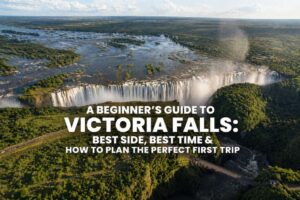
At Victoria Falls, the same regional wet season has charged the Zambezi River to near-peak levels. The falls, known locally as Mosi-oa-Tunya, “The Smoke That Thunders”, reached their thundering apex between March and April 2026. At this volume, the spray is so dense that it rains upward. The roar can be felt in the chest from a kilometre away. A lunar rainbow, one of the rarest atmospheric phenomena on earth, is visible during full moon nights from February through May, when sufficient mist refracts moonlight into a ghostly arc above the gorge.
In East Africa, the Great Migration is progressing on its eternal, 800-kilometre clockwise loop through the Serengeti ecosystem. More than two million wildebeest, 250,000 zebra, and 300,000 gazelle follow the rains in search of fresh grazing, driven not by instinct alone but by an ancient biological clock calibrated over hundreds of thousands of years. The southern Serengeti hosted the calving season from January through March, 500,000 calves born in just a few weeks, a spectacle that turns the plains into both a nursery and a theatre of raw survival. Right now, in April 2026, the herds are entering the rut, bulls competing fiercely for mates on lush green plains with almost no other visitors in sight.
These three events, the Okavango flood, Victoria Falls at peak power, and the Great Migration in full motion, are happening simultaneously. Each is extraordinary on its own. Together, they constitute the most compelling case for an African safari that any living traveller has seen.
The Okavango Delta: On the Ground in the Flood of a Generation
What You Actually See
Ground level in the Okavango during a peak flood year is unlike any other safari experience in Africa or anywhere else on earth.
Your day begins before sunrise. The camp’s wooden walkways, raised on stilts above the floodplain, lead you to a mokorom, a traditional dugout canoe carved from sausage or African ebony wood, where your poler is already waiting, standing at the stern with the long, slender pole that will propel you in near-silence through the channels. These men and women come from communities that have navigated these waters for generations. Their knowledge is not learned from books. They read the water the way a shepherd reads weather, by feel, by instinct, by a lifetime of accumulated attention.
The papyrus parts ahead of you. Jacanas, the birds that walk on lily pads, scatter from their perches. A hippo exhales somewhere in the reeds. The light shifts from grey to copper to gold. And then, in a clearing in the floodplain, you see them: a herd of red lechwe, perhaps a hundred strong, bounding through the shallows in great arcing leaps, their elongated hooves, evolved over millennia precisely for this terrain, carrying them through water that would slow any other antelope to a stumble.
By midmorning, you may transfer to a motorboat for a different perspective: the broader channels, the lily-covered lagoons, the islands where elephants have found dry ground and stand in the shade of fever trees, ears fanning slowly in the heat. African fish eagles, the sound of Africa, some say, call from the treetops. Pel’s fishing owls, among the rarest birds on the continent, sleep in the riverine forest. Malachite kingfishers dart low over the water in flashes of electric blue and copper.
In the afternoons, game drives replace the water. Here the predators gather: lion prides patrolling the flood edges, leopards draped in leadwood trees, cheetahs moving across the open floodplains where the water has just receded, and the grass is fresh and short, ideal hunting ground. African wild dogs, one of the most endangered large predators in Africa, are regularly seen in the Kwara and Moremi concessions. Encountering a wild dog pack on a hunt is one of the most electrifying moments available to a wildlife photographer anywhere in the world.
This year, the flood has done something extraordinary beyond the aesthetics: it has reconnected ecosystems. Animals are responding to areas that have been dry for years, suddenly holding water. Buffalo herds that typically move through certain corridors are ranging further. Predators are establishing new territories along the expanded water edges. The entire ecosystem is recalibrating, and visitors right now are watching it happen in real time.
2026 Ground Conditions: What to Know Before You Arrive
Honesty serves travellers better than marketing, and the 2026 flood comes with both extraordinary rewards and real logistical considerations.
Some road access through Moremi Game Reserve has been temporarily closed due to flooded tracks. Several mobile camp operators have had to reroute logistics or adjust itineraries. A small number of airstrips near the water’s edge have seen temporary closures. For self-drive visitors, some areas are simply inaccessible.
For fly-in visitors staying at established camps, which describes the vast majority of luxury safari guests in the Okavango, none of this is a meaningful concern. Camps operate normally, reached by light aircraft on scheduled or charter flights from Maun. The water that makes road access difficult is the same water that makes the experience exceptional. Experienced operators have adapted. And in most cases, the “problem” areas are the most beautiful areas, deep in the flood, far from any track, accessible only by boat or mokoro.
Flexibility is the only prerequisite. Come with an open schedule, trust your guides, and let the Delta show you what it has decided to be this year. It will not disappoint.
The Luxury Camp Guide: Where to Stay in the Okavango Delta
The Okavango operates on Botswana’s “high-value, low-impact” model, a deliberate choice by the government to keep visitor numbers low, environmental footprint minimal, and the economic benefit high. What this means in practice: camps are small (typically 8 to 24 guests), located on large private concessions where you may not see another vehicle for days, and priced to reflect their exclusivity. Most are accessible only by light aircraft.
For the most comprehensive Okavango experience, consider combining two camps: one water-focused and one land-based, or a mixed camp that offers both. Spending three nights at each gives you time to settle in, build a relationship with your guides, and experience the Delta at the pace it deserves.
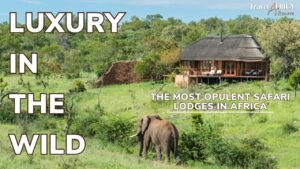
Wilderness Mombo: consistently rated among the finest safari camps in Africa, Mombo sits in the north-eastern corner of Chief’s Island in the Moremi Game Reserve. The wildlife density here is exceptional: large predator populations including lion, leopard, wild dog, and hyena; massive buffalo and elephant herds; and rare rhino sightings from the camp’s pioneering reintroduction programme. Elevated suites overlook a game-rich floodplain. Rates from $2,200 to $3,500 per person per night, fully inclusive.
Wilderness Vumbura Plains: set within a 60,000-hectare private wilderness area bordering Moremi, Vumbura Plains offers both water and land activities year-round, making it an ideal single-camp stay if you want the full Delta experience in one address. Spacious suites have private plunge pools and viewing decks. The camp works in close partnership with the Okavango Community Trust, employing and empowering local villages in a model of sustainable tourism that makes visiting here feel like something more than a holiday. Rates from $2,220 per person per night.
Xigera Safari Lodge: arguably the most visually striking camp in the Delta, Xigera (pronounced “kee-jera”) is entirely solar-powered, plastic-free, and houses what is said to be Africa’s largest private collection of contemporary art in a hospitality setting. Every piece has been handcrafted by African artists and artisans. Set in the heart of the Moremi Game Reserve with access to both permanent water and productive game-viewing plains, this is the address for travellers who want extraordinary design alongside extraordinary wildlife. Rates from $1,800 per person per night.
Camp Okavango: for those who want a pure water camp experience, Camp Okavango sits in the permanent Delta, where the focus is entirely on the aquatic world: mokoro excursions, boat safaris, walking on islands, and some of the finest birdwatching anywhere in southern Africa. Elegant tented accommodation is raised on elevated platforms above the floodplain. In a year like 2026, with deeper channels and more remote areas accessible than at any point in recent memory, a water camp stay becomes something genuinely transcendent. Rates from $1,000 per person per night.
Jao Camp: five tented suites and two ultra-luxury villas set among islands fringed with riverine forests and vast open floodplains. Fresh contemporary design, strong wildlife concentrations, mixed water and land activities, and the intimate scale that makes the Okavango feel like your own private wilderness. Rates from $1,500 per person per night.
Duba Plains Camp: positioned within an 82,000-acre private reserve that serves as the base camp for acclaimed National Geographic filmmakers Dereck and Beverly Joubert, Duba Plains combines vintage 1920s East African aesthetic with ecological sensitivity and exceptional wildlife viewing. Each tent has its own plunge pool and shaded sala. Rates from $1,800 per person per night.
Practical note: all rates are fully inclusive of accommodation, meals, twice-daily camp activities including game drives and water activities, park fees, laundry, and local drinks. Budget separately for premium spirits, champagne, helicopter excursions, and any specialist photography equipment hire.
Victoria Falls: The Smoke That Thunders at Full Power
Standing in the Mist
No photograph prepares you for Victoria Falls at peak flood. Not the aerial shots, not the drone footage, not the most carefully composed image from the world’s finest wildlife photographers. The falls must be experienced through the body, not the eyes.
At peak water levels in April 2026, the Zambezi pours over a basalt cliff 1.7 kilometres wide and up to 108 metres deep. The volume, at its April peak, over a million litres per second, creates a permanent weather system. The mist rises 400 metres above the gorge and can be seen from 50 kilometres away. Walking the trail on the Zimbabwe side, you will need waterproof bags for your camera equipment and expect to be soaked within minutes, even with a poncho. The spray “rains upward”, pushed skyward by the force of water hitting the gorge floor far below.
Through brief gaps in the mist, you glimpse it: a wall of white water, unbroken, thundering, terrifying in the most magnificent possible way. The sound is not a sound so much as a presence, felt in the sternum, in the teeth, in the bones.
This is one of the Seven Natural Wonders of the World. At peak flood in April 2026, it is more wonderful than ever.
Where to Stay at Victoria Falls
The Elephant Camp — perched on a private concession within the Victoria Falls National Park with views of the Batoka Gorge and the rising mist of the falls in the distance, The Elephant Camp offers intimate elephant conservation experiences alongside genuine eco-luxury. Luxury tented suites have private decks, outdoor showers, and panoramic views of the woodlands. The camp is a short drive from the falls, with a resident herd of elephants as frequent visitors to the grounds.
Matetsi Victoria Falls — set on 136,000 acres with 15 kilometres of exclusive Zambezi River frontage, Matetsi is a family-owned property with deep roots in Zimbabwe’s conservation landscape. The interiors celebrate local craftsmanship and artisanal design. Game drives into the private reserve, river activities, and a dedicated conservation programme make this the destination for travellers who want more than a falls experience — they want the full Zimbabwean bush alongside it.
Victoria Falls Safari Lodge — the most established luxury address in town, with an open-air main lodge overlooking a busy wildlife waterhole where elephant, zebra, and impala gather throughout the day. The Boma dinner experience — traditional food, drumming, storytelling under the African night sky — is one of the most warmly remembered evenings on any Zimbabwe itinerary. Walking distance to the falls entrance.
Rates across Victoria Falls luxury properties: $300 to $800 per person per night, including breakfast and most activities.
The Great Migration: What’s Happening Right Now and What Comes Next
The World’s Greatest Wildlife Spectacle
Imagine standing on a rise in the Serengeti at dawn and watching the horizon move.
It is not a trick of the light. The horizon is moving because two million wildebeest are moving, and their combined mass creates a shifting, living, breathing line between earth and sky that stretches further than any eye can comfortably hold. The sound reaches you before the animals do — a low, constant rumbling, punctuated by grunts and bellows, carried across the plains on the morning air. Then they are there, and then there are so many that “there” loses meaning entirely.
The Great Migration is the largest movement of land mammals on earth. It is not an event so much as a permanent condition — a continuous, 800-kilometre clockwise journey through Tanzania’s Serengeti and Kenya’s Maasai Mara that has been repeating, unchanged, for hundreds of thousands of years. It happens every month of every year, in different parts of the ecosystem, offering a different spectacle depending on when you arrive.
The Monthly Migration Map: Where to Be and When
January – March: Calving Season in the Southern Serengeti and Ndutu
The herds concentrate on the short-grass plains of the southern Serengeti, enriched by ancient volcanic ash from the Ngorongoro highlands. These nutrient-dense grasses are exactly what heavily pregnant wildebeest need. In a two-to-three week window in February, approximately 500,000 calves are born — an estimated 8,000 per day at the peak. Most will stand within minutes of birth. Most will be running within hours. Many will not survive the week.
The calving season draws every predator in the ecosystem to the southern plains. Cheetah, lion, leopard, hyena, and wild dog converge on an area suddenly rich with vulnerable prey. The spectacle is raw, emotional, and unforgettable — a daily drama of birth and survival played out on open, low-grass plains where nothing is hidden, and everything is visible. This is the finest season for predator action in Africa.
April (Right Now): The Rut in the Southern-Central Serengeti
The herds are currently beginning their northward movement, and something extraordinary is happening within them: the rut. Male wildebeest are competing aggressively for females, locking horns, charging, displaying, filling the air with grunts and the crash of antlers. This year’s calves are finding their legs, following mothers who are simultaneously navigating the push northward and the relentless interest of territorial bulls.
April is one of the most underappreciated months on the Serengeti safari calendar. The plains are still vividly green from the long rains. The herds are enormous and accessible. There are almost no other visitors — the crowds that characterise July and August are months away. Camp rates are 20 to 30 per cent lower than peak season. For the traveller who values intimacy over spectacle, who wants the Serengeti as it was rather than as it appears in brochures with a vehicle on every horizon, April is the finest month of the year.
May – June: Western Corridor and the Grumeti River Crossings
As the long rains ease and the southern plains begin to dry, the herds start their serious northward march through the central Serengeti toward the Western Corridor. The first major river crossing of the migration cycle awaits them here: the Grumeti River, home to some of the largest Nile crocodiles in Africa. The crossings are smaller and less photographed than the famous Mara River events that follow, but no less dramatic for those who witness them.
June combines the last of the green season’s lush scenery with the first river crossing action. Crowds remain very manageable compared to the July-October peak. For travellers who want drama without the competition for camp spots and vehicle positions, the Western Corridor in June is an excellent choice.
July – October: The Mara River Crossings in the Northern Serengeti
This is the experience that fills the covers of wildlife magazines and the highlight reels of documentary films. The herds arrive at the Mara River — the final barrier between the Serengeti and Kenya’s Maasai Mara — and face their most dangerous crossing. The river is narrow, fast, and lined with crocodiles. The banks are steep and slippery. There is no safe way across.
When the wildebeest finally commit — and they will hesitate for hours, sometimes days, massing on the southern bank in their thousands before a single animal breaks for the water — the crossing is chaos and courage and carnage all at once. Thousands plunge in simultaneously. Crocodiles roll and strike. Some animals are swept downstream. Most make it. The ones who make it climb the far bank and immediately begin to graze, as though nothing happened.
There is nothing else like it in the natural world.
The Mara River crossings occur multiple times through July, August, September, and into October, as the herds move back and forth. Book 12 to 18 months in advance for the best camps in the northern Serengeti during these months. This is the single most demand-constrained safari experience in Africa.
November – December: The Southern Return
The Maasai Mara’s grasses thin. The southern Serengeti begins to green with the short rains. The herds feel the change and begin streaming south in fast-moving columns, covering enormous distances in a single day. By December, the first animals are arriving back at Ndutu, and the cycle prepares to begin again.
November and December offer excellent game viewing at very low prices and almost no crowds. For photographers, the light at the beginning of the short rains — dramatic skies, golden grass, animals moving at speed — is exceptional.
Plan Your 2026 Africa Safari with Travel Africa & More
If this is the year you decide to go, and it should be, the single most important step you can take is partnering with people who know these destinations not from research but from direct, repeated, firsthand experience. Travel Africa & More is precisely that kind of partner. A safari planning company built by people who love Africa and have spent their careers learning its landscapes, its lodges, and its seasons, Travel Africa & More designs journeys that are deeply personal rather than template-driven, choosing the right camps for your priorities, timing your visit for the optimal wildlife moments, and managing every logistical detail so that the only thing you need to think about on the ground is what you are seeing. Their itineraries cover Botswana, Tanzania, Zimbabwe, Zambia, Kenya, and beyond, and their signature routes, including a Victoria Falls to Okavango Delta safari and a dedicated Great Migration experience in Tanzania, are exactly what the 2026 season demands. From your first enquiry to your final sundowner on the Zambezi, they are with you. Start planning the safari that this extraordinary year deserves.