
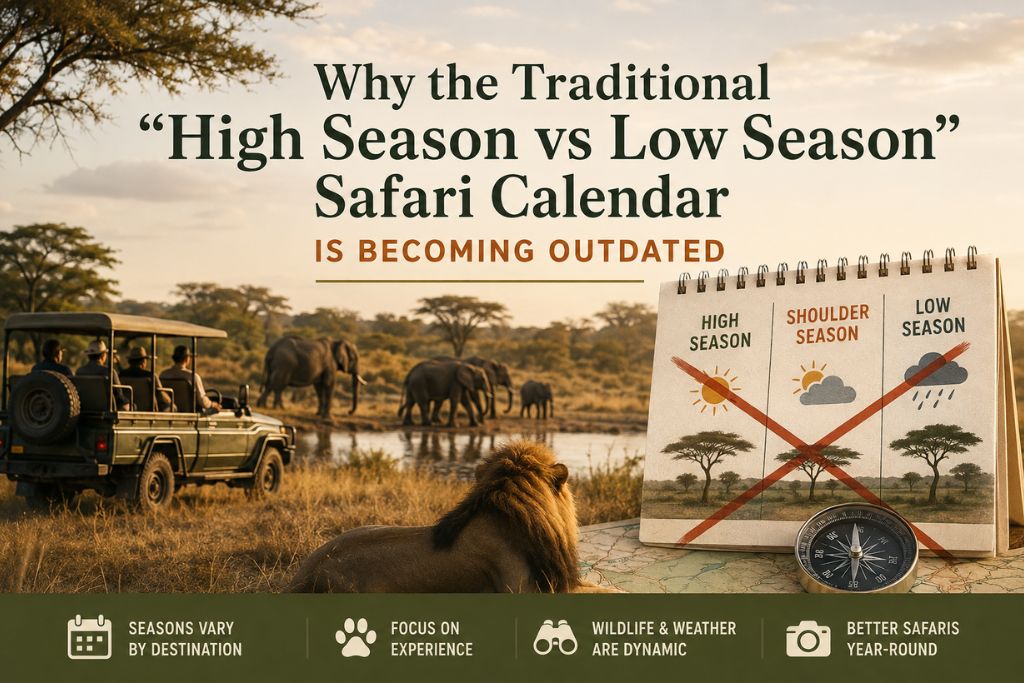
For many travelers planning an African safari begins with a familiar question: What is the best time to go on safari?
The traditional answer often points toward the dry-season months, when wildlife can be easier to spot and demand is highest. But Africa does not operate on one universal safari calendar.
Kenya and Tanzania have different wildlife cycles, while Botswana’s Okavango Delta follows a seasonal flood pattern that can make the relationship between rain and water surprisingly complex. Zambia and Zimbabwe also offer different experiences depending on the season.
Why the Traditional Safari Calendar Is Changing
The terms high season, low season, green season and shoulder season are still useful for understanding safari travel. The problem comes when they are treated as universal rules.
High season often overlaps with dry conditions, strong wildlife visibility and higher demand. Low or green season can bring rainfall, lush vegetation, seasonal birdlife and fewer visitors. Shoulder season falls between these periods and can offer a combination of conditions.
But the timing and characteristics vary significantly by destination.
A traveler looking for the Great Migration may choose dates based on herd movements. A wildlife photographer may value green landscapes and dramatic skies. Someone planning a second safari may prioritize private conservancies or remote areas over peak-season wildlife concentrations.
This is why African safari seasons should be considered destination- and experience-specific, rather than simply divided into “good” and “bad” months.
What Do High, Low, Green and Shoulder Seasons Mean?
High Season
High or peak season generally corresponds with periods of strong demand.
In many safari destinations, dry conditions can reduce vegetation and concentrate wildlife around remaining water sources. These conditions can make animals easier to locate in some areas.
The trade-off is demand.
Travelers can encounter:
- Higher accommodation rates
- Greater demand for popular camps
- More advance booking requirements
- More vehicles in well-known wildlife areas
- Limited availability at sought-after properties
High season can be an excellent choice, particularly for first-time safari travelers, but it is not automatically the right choice for everyone.
Low or Green Season
Green season traditionally coincides with warmer, wetter months. Rainfall can bring new vegetation, changing landscapes and seasonal bird activity. Wildlife may also spread out as surface water becomes more available.
For some travelers, this creates opportunities that are less prominent during the dry season.
Green-season advantages can include:
- Lush landscapes
- Seasonal birdlife
- Dramatic skies
- Photography opportunities
- Fewer visitors in some destinations
- Potentially lower safari rates
There can also be trade-offs, including rain, muddy roads or seasonal camp closures in certain areas.
Shoulder Season
Shoulder season sits between peak and low periods.
It can provide a balance between:
- Wildlife viewing
- Visitor numbers
- Weather
- Availability
- Safari costs
Recent safari industry reporting indicates growing interest in shoulder months, particularly among travelers looking for a more unhurried experience, including those weighing a 14-day trip against a shorter 7-day itinerary.
However, shoulder season is not one fixed period across Africa. Its timing depends on the destination.
The Best Safari Season Depends on Your Experience
Instead of beginning with a month, begin with your priorities.
| Travel Priority | Seasonal Consideration |
|---|---|
| First safari | Wildlife visibility and weather |
| Wildlife photography | Light, landscapes and animal behavior |
| Birdwatching | Seasonal bird activity |
| Fewer visitors | Shoulder or green season |
| Walking safari | Local weather and operating conditions |
| Water-based safari | Seasonal water levels |
| Great Migration | Location and movement of the herds |
| Lower rates | Low or shoulder season |
| Repeat safari | Remote areas and specialist experiences |
This approach is particularly relevant to travelers who have already experienced a classic Big Five safari and want something different the second time.
East Africa: Timing Depends on the Destination
Kenya: Beyond the Peak Safari Months
Kenya demonstrates why there is no single answer to the question of the best time for a Kenya safari.
The Maasai Mara, Amboseli and Laikipia provide different environments and experiences. Travel Africa & More’s Kenya itineraries, for example, distinguish peak-season travel from April–May and November off-season periods, while also highlighting private conservancies and activities such as walking and conservation experiences.
For travelers seeking a classic wildlife experience, dry-season conditions can be attractive. But travelers interested in fewer visitors, greener landscapes or private-conservancy experiences may consider other periods.
The right timing depends on what you want from Kenya.
Tanzania: Different Regions, Different Seasons
Tanzania makes the same point even more clearly.
The Serengeti, Ngorongoro Conservation Area, Tarangire and southern Tanzania do not offer identical seasonal experiences.
The Great Migration adds another layer because the herds move through the Serengeti ecosystem rather than remaining in one location all year — a journey our Northern Tanzania itinerary is built around.
Travel Africa & More’s current southern Tanzania itineraries identify June–October as peak season, November–December as shoulder season and January–March as green season, with different wildlife and landscape characteristics across these periods.
So instead of asking only “What is the best month for Tanzania?”, consider what you want to see and where you want to spend your time.
Southern Africa Shows Why “Dry Season = Best” Is Too Simple
Botswana: Water Does Not Always Follow the Rain
The Okavango Delta is one of the best examples.
Its seasonal flood is influenced by rainfall in Angola, with water traveling through the river system before reaching Botswana. As a result, Botswana’s dry season can coincide with important periods of water availability in the Delta. Travel Africa & More’s 2026 coverage highlights how seasonal flood conditions can dramatically influence the Okavango experience.
This means travelers interested in mokoro excursions, boating and water-based wildlife viewing need to consider the timing of the flood, not simply whether Botswana is experiencing its rainy season.
Zambia: Seasonal Changes Can Alter the Safari Style
Zambia is particularly relevant for travelers interested in walking safaris.
Travel Africa & More currently identifies June–September as peak season, October as a period of strong wildlife concentration around water and January–March as green season, when landscapes become lush and visitor numbers can be lower. Our Essence of Zambia Safari is built around these shifts, pairing South Luangwa and the Lower Zambezi with a Victoria Falls extension.
The best period therefore depends on whether you prioritize concentrated wildlife viewing, walking, photography or quieter landscapes.
Zimbabwe: Safari and Victoria Falls Have Different Seasonal Stories
Zimbabwe adds another consideration when Victoria Falls is combined with a safari.
Travel Africa & More’s Botswana and Zimbabwe itinerary notes peak Victoria Falls water levels around May–July/August, while August–January generally provides lower water levels and clearer views of the Falls.
A traveler combining wildlife with Victoria Falls should therefore consider both safari conditions and waterfall conditions when choosing travel dates.
Is Low Season Really a Bad Time for Safari?
Not necessarily.
Calling it “low season” describes travel demand more than safari quality.
For some travelers, green or low season can provide:
- Fewer visitors
- Green landscapes
- Seasonal birdlife
- Strong photography conditions
- Different animal behavior
- Greater accommodation availability
- Potentially lower rates
But these advantages need to be balanced against rainfall, road conditions, wildlife distribution and seasonal camp operations.
The question is not whether low season is good or bad.
It is whether low season is right for your particular safari.
Why Shoulder Season Deserves More Attention
The growing interest in shoulder-season travel suggests that travelers are becoming less focused on simply visiting Africa during the busiest months.
For US travelers, September and October can be particularly interesting because they fall immediately after the traditional Northern Hemisphere summer vacation period. Industry data also shows strong growth in these months.
Shoulder-season travel can potentially offer a useful combination of:
- Good wildlife opportunities
- Fewer visitors
- More camp availability
- Different landscapes
- More flexible itinerary planning
But conditions still need to be assessed destination by destination.
How to Choose the Right Safari Season
Before booking your African safari, ask five questions:
1. What do you want to experience?
Wildlife, migration, birding, photography, walking or water-based activities may each point toward different dates.
2. Which destination supports that experience?
Choose the experience first, then identify the destination.
3. What seasonal conditions matter?
Consider rainfall, water levels, vegetation, wildlife movements and camp operations.
4. How important are crowds and cost?
If your dates are flexible, compare peak, shoulder and green-season options.
5. Can your itinerary combine different experiences?
A multi-country African safari can sometimes combine different ecosystems and seasonal conditions within one journey — browse our full range of itineraries for inspiration.
There Is No Single Best Time for an African Safari
The traditional high-season versus low-season model is useful as a starting point, but it does not tell the whole story.
The best safari season depends on the destination, wildlife, weather, activities and traveler.
High season may be ideal for classic game viewing. Green season can appeal to photographers and birdwatchers. Shoulder season may suit travelers looking for a balance between conditions, availability and visitor numbers.
Travel Africa & More can help build a tailor-made safari around those priorities, rather than simply following a standard seasonal calendar.






![Some birds build nests. The Hamerkop builds an entire mansion.
And the most impressive part? It's all built by just two birds!
Thousands of sticks, twigs and other materials come together to create a massive, roofed structure - complete with its own entrance and nesting chamber.
Proof that some of Africa’s most incredible wildlife wonders come from its most unexpected architects.
Next time you're on safari, don't just look for wildlife. Look up!
📩 DM us to discover Africa beyond the expected.
[ hamerkop, hamerkop bird, African birds, bird nests, African wildlife, birdwatching safari, African birding safari, wildlife facts, safari in Africa, African safari, nature photography, luxury African safari ]](https://travelafricamore.com/core/modules/313e568472/img/placeholder.png)